Oversight and future directions: the leverage we need to make palliative care core business in aged care
Womenjeka: a word that means more than hello. It means coming together for purpose.
I acknowledge the Traditional Owners of the land on which we meet, the Boonwurung people of the Kulin Nation, and pay my respects to Elders past and present. I want to situate ourselves here: this is the place where the freshwater and the saltwater of the Birarung used to meet. And that is apt for us today.
I also acknowledge Aboriginal and Torres Strait Islander peoples here today and recognise that conversations about dying well must always include culture, Country, kinship and community.
Thank you for the invitation to speak with you today – which is also the middle of Advance Care Planning week!
This conference brings together people who understand, better than most, what it means to care for someone at the end of their life—not just clinically, but emotionally, spiritually and relationally. You understand that palliative care is not an 'add‑on'.
It is not a service you switch on at the last minute. It is a way of caring.
But I want to open by naming what I think is sometimes missing from our policy architecture.
Palliative care is not just a discrete set of services. And ageing is not just a discrete set of services.
They are deeply human experiences—social, relational, and often spiritual.
That is why I want to frame this whole speech through the broader obligation that communities should encourage, support and celebrate care for one another through serious illness, frailty, ageing, dying, grief and bereavement.
It’s the old ‘village mentality’, and indeed the First Nations approach to eldership, death and dying that we have somehow lost through the way we ‘systematise’ things into siloes.
This approach reminds us that palliative care and end‑of‑life care is not something the health system does to people. It’s something a society does with people—through families, neighbourhoods, workplaces, local government, faith communities, clubs, and civic life.
And it gives us a powerful reform test: Are we building an aged care system that makes community, connection and compassion easier, or one that unintentionally crowds them out?
Because when we get the social and spiritual side right - when we stop treating it as 'nice to have' – that’s when we change the dial.
The core proposition of what I want to talk to you about today is this: palliative care must be 'how we care', not 'what we do at the end'.
Many people in aged care will die while receiving services. The Royal Commission was explicit that palliative and end‑of‑life care should be core business in aged care, and that too often it has not been delivered to community expectations.
So, when we say, 'make palliative care core business', we are not asking for a specialist overlay. We are asking for a system where palliative care principles are embedded in:
- everyday care pathways
- workforce capability
- standards and assurance, and
- funding and incentives.
My Office exists to scrutinise how the Commonwealth administers, regulates and funds aged care, and to call out where settings are not delivering the outcomes Parliament has promised.
In that spirit, I want to add three provider‑facing messages to this conference conversation:
- The new Aged Care Act must translate into the new Standards—and that translation must be visible on the ground. Providers need an operational vision for end‑of‑life care, not a reactive tweak when someone deteriorates.
- Don’t wait for government to tell you how to do it—or even to tell you to do it. Integrate it now.
- We still have a long way to go, especially in building a workforce that is fit to deliver end‑of‑life care across a raft of settings
So what has really transformed under this new Aged Care Act?
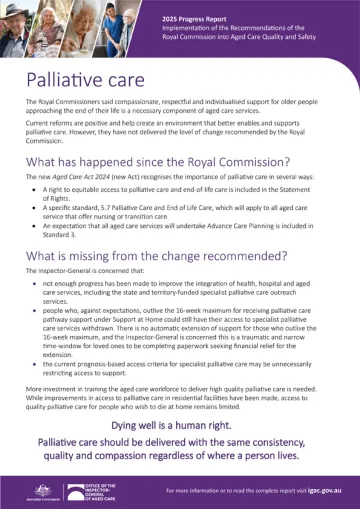
The new Aged Care Act enshrines palliative care as a legal right. The new Statement of Rights says that every older person has a right to equitable access to palliative care and end‑of‑life care when required, alongside dignity, autonomy, and respect for culture and spirituality.
By embedding this right in primary legislation—and requiring providers to deliver care consistent with it—the Act shifts palliative care from a discretionary or specialist service to a core entitlement that the aged care system must actively enable and uphold
This then translates into a dedicated palliative and end‑of‑life care standard (5.7) for services offering nursing or transition care, alongside expectations about advance care planning.
But here is the difference between legislation and lived reality:
A right on paper becomes real only when a provider can answer, confidently:
- Who is accountable for recognising deterioration early?
- How we ensure symptom management is timely and consistent?
- How we communicate preferences across shifts, disciplines and settings?
- How we involve family and community—not as visitors, but as part of care?
- And for me – most critically: how we support spiritual and psychosocial needs as routinely as physical needs?
I want to pick up on this last point.
In developed world health systems like ours, dying has become increasingly medicalised.
End‑of‑life care is often organised around symptoms, interventions, protocols and risk management.
Yes, they are important – but they are NOT the whole picture. A substantial body of research shows that while physical suffering may be addressed, spiritual and existential distress is frequently unmet, even in high‑quality palliative care services.
Studies consistently find that people approaching death are grappling with questions of meaning, identity, reconciliation, belonging, fear, hope and transcendence—questions that medicine alone cannot answer.
Dying, is not just a biological event. It is an intensely spiritual event—whether or not that spirituality is religious. Research from across palliative settings shows that people often 'hunger' for meaning, connection and relational depth at the end of life, and that when these needs are ignored, suffering persists even when symptoms are well managed.
This is where the new Aged Care Quality Standards matter deeply. The Standards explicitly recognise that good palliative care includes meeting a person’s spiritual, cultural and psychosocial needs, not just managing pain or physical decline. But this may be one of the hardest expectations for providers to facilitate—not because it is unimportant, but because it cannot be delivered in the same way as clinical care.
I want to be clear: this is not about turning aged care workers into chaplains or counsellors.
It is about facilitation, not provision. It is about creating the conditions where spiritual care can occur: allowing space for conversations, supporting connection with family, culture, faith or community, and ensuring the person is not reduced to a body that is failing, but recognised as a person who is still becoming.
If we fail to hold this line, we risk seeing end‑of‑life care as something done to the body, when it is just as much about the mind, the spirit, and the relationships that give a life meaning. And if the new Standards are to be realised as they were intended, this is one of the most profound shifts they ask of us.
SO
That is not a compliance exercise. That is an operating model – and I suspect it may be different to what a number of providers have in play right now.
My message to providers is this: You need a vision for how end‑of‑life care fits your operations. Not as a last‑minute patch. Not as a 'clinical pathway' that sits in a folder. But as a shared organisational approach that shapes rostering, training, escalation, documentation, family support, and partnerships with specialist services and community assets.
If you embrace the Compassionate Communities lens, you stop treating the 'non‑clinical' domains as optional.
You understand that a good death includes connection, meaning, culture, dignity, story, and belonging.
And you embed those things long before the last 72 hours.
So going back to my second message: this is the one people sometimes find confronting—because it asks something of providers immediately.
Don’t wait for government to tell you how to do this—or that you should do it. Integrate it now.
Why? Because we already know what happens when systems are slow and crises are fast.
The My Aged Care Review that my Office recently did constantly demonstrated the system’s inability to triage urgent support—particularly for people who are terminally ill or seeking palliative care.
We know that the system is not responsive to rapid decline that requires proactive response. We know the longstanding, ongoing gaps: the integration between health, hospital and aged care remains inadequate; and time‑limited pathways risk abrupt withdrawal of support for people who outlive arbitrary windows.
So the practical implication is clear: If you wait for perfect guidance, people will keep experiencing imperfect care.
What does 'integrate now' mean in real terms? I think it means providers act on three commitments starting before the next reform milestone, not after it.
First: Make palliative care an everyday pathway, not a crisis response.
When we talk about integrating palliative care now, the first commitment is to make it an everyday pathway, not something triggered only by deterioration or prognosis.
I’ve just talked about how in developed systems like ours, dying is often over‑medicalised. Care pathways are designed around symptoms, escalation and intervention are important, but incomplete. What is often missed are the deeper questions people carry long before the final days: questions of meaning, fear, reconciliation, identity and belonging.
If palliative care enters only at the point of crisis, we reduce dying to a technical problem of the body. But when it is embedded early, it creates space - space for conversations, for reflection, for spiritual and existential needs to surface in their own time.
This is exactly what the new Standards are pointing us toward. They ask providers not just to manage decline, but to recognise and respond to the whole person - physical, psychosocial, cultural and spiritual. That shift cannot happen if palliative care remains a late, reactive add‑on.
Secondly: Treat families, culture and community as part of the care unit.
The second commitment is to stop seeing end‑of‑life care as something delivered solely by services, and to start seeing it as something held by relationships.
One of the consequences of medicalising dying is that we can quietly displace families, culture, faith and community to the margins; visitors rather than participants. Yet the evidence is clear that spiritual wellbeing at the end of life is deeply relational. People draw meaning not from treatment plans, but from connection: with loved ones, with culture, with story, with whatever gives their life coherence.
The new Standards explicitly recognise spiritual and psychosocial needs—but this is where providers often feel most uncertain.
But your role can be about facilitation: creating the conditions where those relationships can do their work. Making room for family presence. Supporting cultural and spiritual practices. Linking people back to community, faith leaders, Elders, or simply to the people who know them best.
If we fail to do this, we risk delivering technically competent care that still leaves people spiritually alone.
Third: Make preferences portable—and include what matters beyond the body
The third commitment is to make people’s preferences truly portable across settings—and to be honest about what those preferences usually include.
Advance care planning is often framed around treatment decisions: what to start, what to stop, what to refuse. But for many people, what matters most at the end of life is not a medical choice at all. It is how they are seen. Who is with them. Whether their beliefs, values and identity are honoured.
If our systems only capture preferences about the body, we flatten the experience of dying. We turn it into a clinical transaction, rather than a human passage.
The challenge and the opportunity in the new Standards is to broaden what we mean by 'preferences', and to ensure that information about spiritual, cultural and relational needs travels with the person, just as reliably as medication charts do.
We have a long way to go, particularly in building a workforce that can deliver end‑of‑life care in a range of settings: home, community, residential care, and across hospital interfaces.
The Royal Commission itself said workforce expertise and capability in palliative care is urgent and essential, and called for clearer provider responsibilities and training expectations.
I have been blunt that there is no mandatory, regular palliative care training for staff—and that reform to date has not yet achieved the transformation envisaged.
This is exactly where 'Comprehensive Palliative Care in Aged Care Measure' comes into play.
The measure aims to improve palliative care in residential aged care facilities and strengthen access to quality palliative care as part of an integrated health‑aged care system.
It provides evidence of the types of activities that build capability, BUT, it also makes visible the ongoing barriers.
I do worry that a program that has been so well evaluated is due to end in July.
To be clear - my message is not: 'we have a pilot, problem solved'.
My message is: we have a learning base, now we need scale and system alignment.
As Inspector‑General, my job is to call out when the system design is not matching the promise. And we have made a promise:
The new Aged Care Act is clear: palliative care is a right.
The new Standards are clear: dignity, culture, spirituality, connection and meaning are not optional extras.
Palliative care is not something we add on at the end. It’s not a specialist service we call in when the system has run out of options.
And the evidence is also clear: when we reduce dying to a clinical event, we may manage symptoms - BUT we leave people alone in the deepest parts of their humanity.
So to act on this promise, we are not being asked simply for ‘better compliance’.
We are being asked for a different operating logic.
One that recognises that end‑of‑life care is not just about what happens in the last days, but about what we make possible long before that.
One that understands that providers do not have to own spirituality - but they do have to make room for it.
And one that sees families, culture and community not as peripheral to care, but as central to it.
If we get this right, we do more than improve aged care - we restore something we have lost through systematisation and siloes—the sense that no one should die unseen, unheard, or disconnected from what gives their life meaning.
This is the test of this reform.
And it is the work that lies ahead of all of us.
Thank you.